Capability / 03
Turn repeated work into engineered workflows.
PACSAL (Programming, Advanced Cyber-Security & Automation Lab) designs automation and AI-assisted systems that connect tools, reduce manual work, and create reliable operational workflows.
We combine deterministic automation, intelligent decision support, human approval, and system integration to turn repeated operational work into controlled, observable processes.
AutomateOrchestrateApproveExecuteImprove
- Local AIOn-premise models
- Cloud AIFrontier models
- APIExternal services
- DataFiles · Databases · Systems

PACSAL
(Programming, Advanced Cyber-Security & Automation Lab)
Automation Core
Orchestrate · Route · Execute · Monitor · Learn · Improve
- Human ApprovalReview · Approve · GuideRequired
- Action / ExecutionApps · Systems · Notifications
- VerificationResults · Logs · State
Automation Areas
Automation engineered for real operations.
Core capabilities we design and implement across business systems, internal tools, and operational workflows.
Workflow Automation
Connect tools and eliminate repetitive operational work.
Business Process Automation
Digitize and streamline end-to-end business processes.
API Orchestration
Connect systems and coordinate reliable data flow.
Browser Automation
Automate repeatable web-based operational tasks.
AI-Assisted Operations
Use AI to support analysis, generation, and operational workflows.
Local AI
Run AI models inside your own environment where control and privacy matter.
Cloud AI
Use managed AI models where scale, capability, or flexibility are valuable.
Human-in-the-Loop Systems
Keep people in control at important decision points.
AI Philosophy
AI where intelligence is useful. Deterministic systems everywhere else.
PACSAL (Programming, Advanced Cyber-Security & Automation Lab) uses AI deliberately. We apply AI to problems that benefit from flexible reasoning, language understanding, classification, generation, and analysis — while deterministic software handles work that requires reliability, control, repeatability, permissions, and auditability.
Use AI for
Probabilistic. Creative. Supportive.
GenerationCreate content, summaries, drafts, and structured output.
ClassificationCategorize and extract information.
AnalysisIdentify patterns, insights, and useful signals.
Decision SupportPresent options and context without silently taking control.
Natural LanguageInterpret or generate human-oriented text where appropriate.
Unstructured DataHelp interpret information that does not follow strict schemas.
Use deterministic systems for
Predictable. Reliable. Operational.
SchedulingRun work at explicit times and conditions.
PermissionsEnforce access and system boundaries.
ValidationCheck rules and expected state.
RetriesHandle operational failure predictably.
ExecutionPerform approved actions consistently.
AuditRecord important system actions.
State ManagementMaintain reliable workflow state.
Featured Project
Socium
A local-first AI Business Operating System.
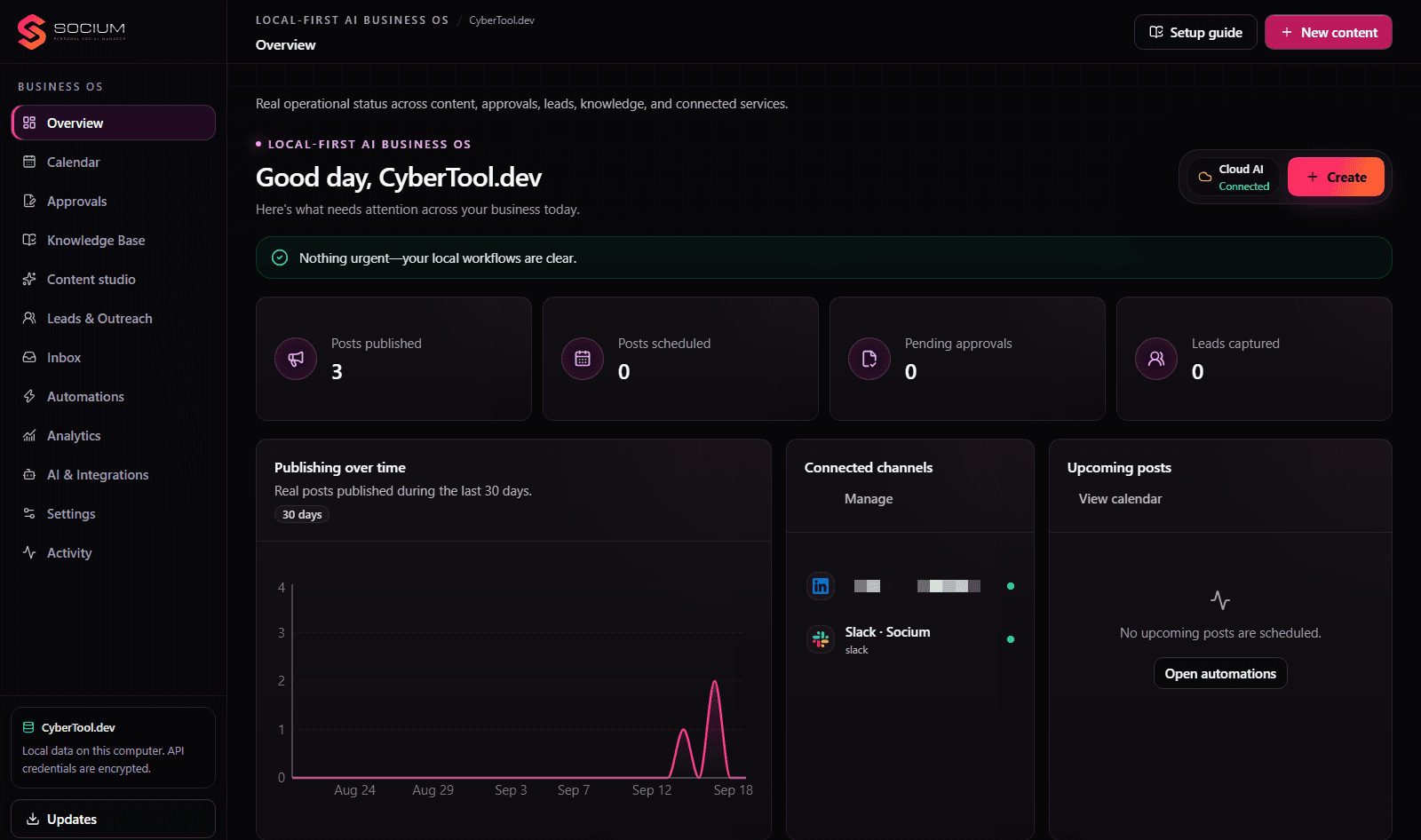
Socium brings together business knowledge, approvals, inbox workflows, publishing, automations, and AI-assisted operations in one local-first platform.
It demonstrates PACSAL (Programming, Advanced Cyber-Security & Automation Lab)'s approach to automation: AI proposes and assists, while durable workflows, explicit approvals, permissions, and deterministic execution control operational actions.
Local-First
Keep durable business data in the user's environment.
Human Approval
People remain in control where important actions require review.
Workflow Engine
Coordinate recurring and event-driven operational work.
Durable State
Keep workflow progress, approvals, and outcomes traceable.
Integrations
Connect publishing, email, messaging, AI providers, and other systems.
Local or Cloud AI
Choose model infrastructure by privacy, control, and capability needs.
Process / Automation
A structured approach. Real outcomes.
We follow a practical engineering process to design, implement, control, and improve automation and AI-assisted systems.
- 01
Discover
Identify goals, repeated work, friction, risks, and high-value automation opportunities.
- 02
Design
Map the workflow, dependencies, systems, approval points, and expected outcomes.
- 03
Connect
Integrate the required tools, APIs, systems, data sources, and model providers.
- 04
Automate
Build deterministic workflows, business rules, AI-assisted steps, retries, and operational logic.
- 05
Approve
Add human oversight where judgment, risk, or accountability requires it.
- 06
Improve
Observe results, learn from failures, measure friction, and refine the system.
Local vs Cloud
The right environment for the right job.
PACSAL (Programming, Advanced Cyber-Security & Automation Lab) designs systems using local AI, cloud AI, or a hybrid approach depending on privacy, capability, infrastructure, cost, latency, and operational requirements.
Local AI
- Data stays in your environment
- Greater control over sensitive workloads
- Can support offline or restricted environments
- Useful where external model calls are undesirable
- No dependency on a hosted PACSAL (Programming, Advanced Cyber-Security & Automation Lab) account
Control. Privacy. Independence.
Cloud AI
- Access to advanced managed models
- Easy provider switching where architecture allows
- No local model infrastructure required
- Useful for complex or high-capability workloads
- Can scale without maintaining local inference hardware
Scale. Capability. Flexibility.
Hybrid
- Use local AI for sensitive workloads
- Use cloud AI where additional model capability is valuable
- Route tasks according to workload requirements
- Maintain a consistent workflow across both environments
- Choose the right model for each task
Balance. Route. Adapt.
Real-World Application
Automation across the system lifecycle.
From input to feedback, automation and AI work together across the complete operational cycle.
- 01
Input
Data · Events · Requests · Changes
- 02
Validation
Check · Enrich · Normalize
- 03
Orchestration
Route · Coordinate · Apply business logic
- 04
AI Assistance
Analyze · Generate · Classify · Assist
- 05
Human Approval
Review · Edit · Approve · Reject
- 06
Action / Execution
Update systems · Send · Publish · Trigger · Store
- 07
Feedback
Log · Measure · Learn · Improve
Higher ReliabilityFewer uncontrolled or inconsistent operations.
Lower FrictionLess repeated manual work.
Greater CapacityPeople can focus on work that benefits from human judgment.
Let's automate what's next
If a process repeats, it can probably be engineered better.
Tell PACSAL (Programming, Advanced Cyber-Security & Automation Lab) what you're trying to automate or improve. We'll help you design a practical, secure, and controlled system.